The Archive
Every service you have translated, kept as text in every language — how to read it, correct it, delete it, and what is never stored at all.
Written By Dennis Dueck
Last updated About 1 month ago
Every service you have translated, kept
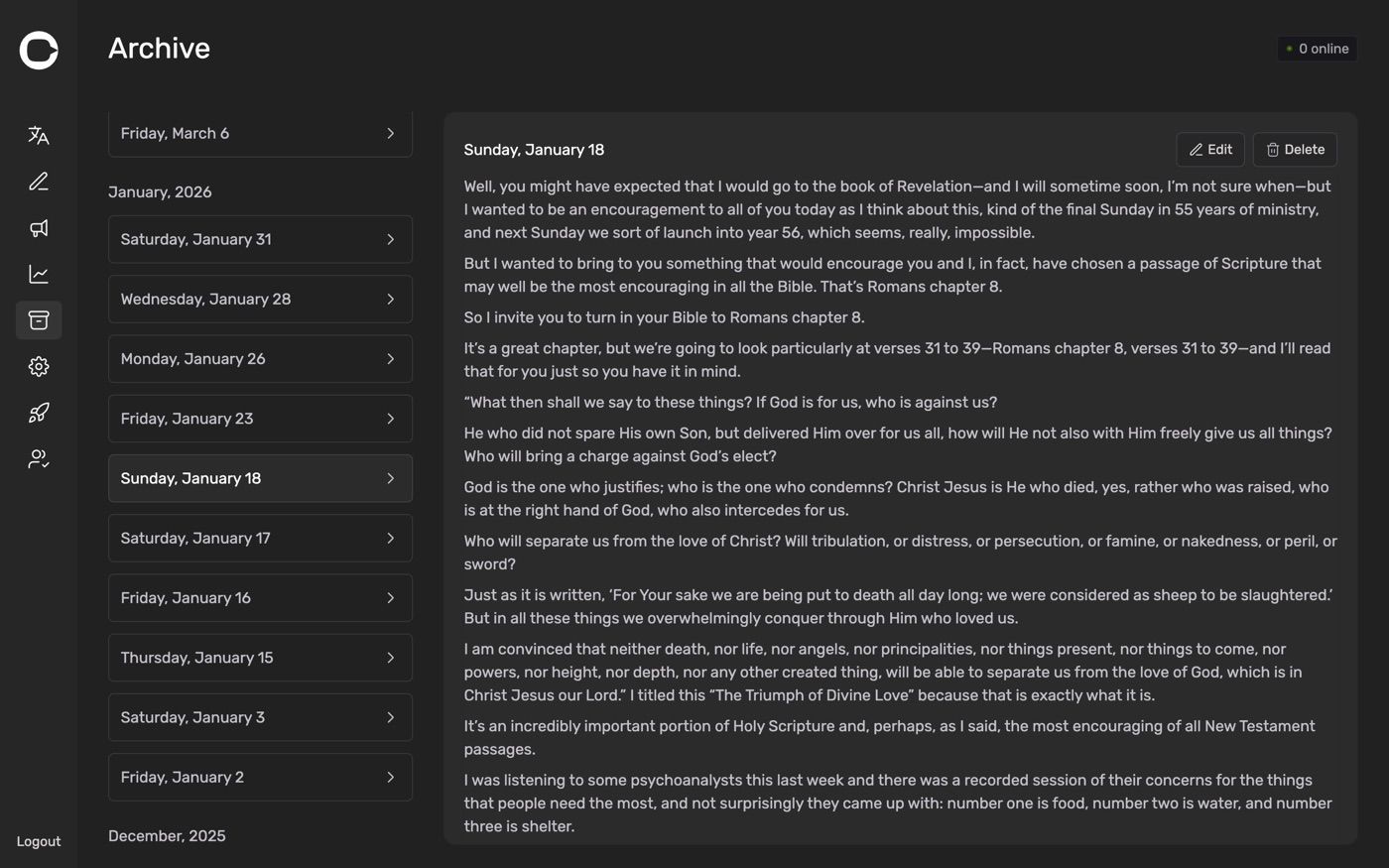
The Archive holds the text of every service you have run, in every language you translated it into. Your congregation can read a sermon again during the week, and you can check how the system actually performed.
Where can I find the Archive?
Go to https://admin.churchtranslation.org/archive, or click Archive in the sidebar.
Pick a date at the top of the page and that service opens beneath it.
What your congregation sees
Visitors have their own Archive in the app's menu. They pick a date and read the whole service in whatever language they have chosen.
This matters more than it first appears. Someone who could not come on Sunday reads it on Tuesday. Someone whose language arrived late catches up on what they missed. Someone who wants to think about a passage properly reads it slowly, without a preacher moving on.
Before your first translated service, they see No translations available yet. Translated sermons will appear here once the service is over.
Tidying up a service
The transcript is what the AI heard. It is usually very good, and occasionally it is not — a name misheard, a phrase caught mid-cough, someone's aside picked up on an open microphone.
Click Edit to clean it up:
Click Edit.
A small bin icon appears next to every line. Click it on anything you want removed.
Click Save, or Cancel to leave things as they were.
This is worth doing occasionally, particularly after a service where the microphone caught something private. It is not worth doing every week.
Reading last week's archive is also the best way to build your Keyword Booster list. Every misheard name is written down for you — see The Keyword Booster.
Deleting a service
To remove a whole day, click Delete and confirm — This action will delete all translations for this day.
That removes the service in every language at once, for you and for your congregation. It cannot be undone, so pause before you use it on a service anyone might still want.
Good reasons to delete a day:
A test session that is cluttering up the list
A service where something genuinely private was said over a live microphone
A meeting that was never meant to be public
What is and is not kept
The text is kept. In every language you translated into, until you delete it.
The audio is never kept. Not for a minute. The sound of your service is translated as it is spoken and then it is gone — there is no recording of your service on our servers, and no way for anyone to produce one. If a member of your congregation asks whether the sermon is being recorded, the honest answer is no.
There is no bulk download. You can read, correct and delete from this page, but there is no button that exports a service as a file. If you need a transcript for your own records, copy the text out of the page.
Gaps in one language
Sometimes a language's archive has a stretch that appears in the language spoken at the service instead, with a short explanatory note.
That is not a fault. If nobody was reading in that language at that moment, it was not translated — which is exactly the saving that keeps your bill down. There is nothing to recover afterwards, because the translation was never made.
If people in your church regularly read the archive during the week without joining the live service, their language will keep showing these gaps. Two ways to fix it:
Choose a longer wait time before languages switch off
Add their language yourself, and use the setting that leaves manually added languages alone
Both are covered in Stewardship: Making the Most of Your Resources. It is worth ten minutes if you know you have archive readers.
Getting more out of it
Read last week's before you prepare this week's. Ten minutes tells you what to add to the Keyword Booster.
Point new members at it. People who are unsure whether the translation is any good are reassured by reading a real service rather than being told.
Check a language you don't speak. Ask a member of your congregation who reads it to look at one service and tell you honestly how it reads. It is the only quality check that means anything.
Was this helpful?
Still need help? Ask the team